 tellnova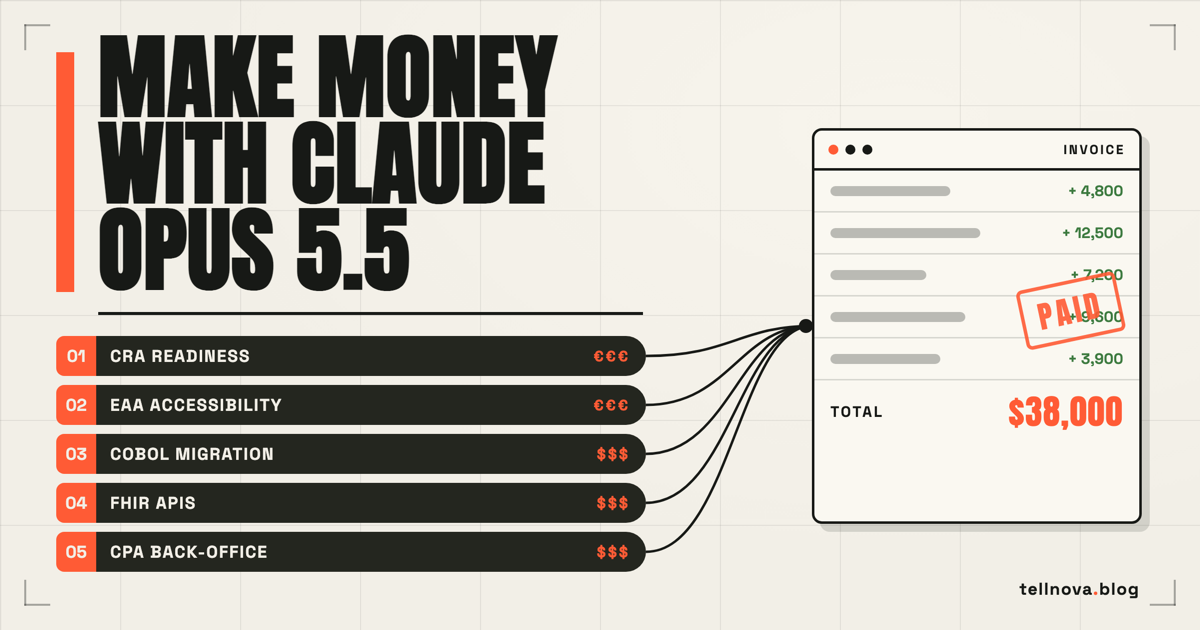
The fastest way to make money with Claude Opus 5.5 is not building another AI wrapper app. It is selling outcomes into markets where a legal deadline or a talent shortage has already created the demand, and using the model to deliver work that used to take a team. Anthropic released Claude Opus 5.5 on September 22, 2026, at $4 per million input tokens and $20 per million output — cheaper than Opus 5 while topping the knowledge-work and computer-use benchmarks. Here are five concrete service businesses that capability opens up, and the one-person delivery stack for all of them.
The economics: why Opus 5.5 makes these viable
Two numbers matter. First, price: Opus 5.5 undercuts its predecessor at $4/$20 per million tokens, with cache reads at $0.20 — long code-audit sessions where the model re-reads the same context stop being expensive. Second, capability: it leads GDPval-AA v2.1, the benchmark that grades professional deliverables like reports and analyses, at 1846 Elo, and scores 81.8% (partial) on OSWorld 2.0 computer use. Anthropic's launch materials describe multi-hour autonomous audits of six-figure-line codebases and a 680k-line migration completed in under a day. That profile — long unattended runs over large codebases producing professional-grade output — is precisely what the five businesses below sell.
1. CRA readiness for software vendors selling into the EU
Since September 11, 2026, anyone selling software or connected devices into the EU must report actively exploited vulnerabilities within 24 hours (early warning) and 72 hours (full notification) under the Cyber Resilience Act. The bigger wave lands December 11, 2027: secure-by-design requirements, SBOMs, technical documentation, CE marking, and five years of security support. Law firms are already sounding the alarm, and most small vendors do not know what is inside their own products.
The package you sell: generate the SBOM, scan and upgrade end-of-life dependencies, stand up the 24/72-hour triage process, draft the technical documentation. A background agent handles the audit and the dependency upgrades; you review the diffs and own the client relationship.
2. Accessibility remediation under the European Accessibility Act
The EAA has been enforced since June 28, 2025, with the first lawsuits filed in France in late 2025 and reported fines ranging from tens of thousands of euros in Ireland to €1M in Spain. E-commerce, banking, travel, and telecom sites are all in scope.
What you sell is fixing accessibility in the actual code — keyboard navigation, screen-reader labels, contrast, form semantics — not an overlay widget. This is thousands of small edits across a codebase, which is exactly the shape of work coding agents are strongest at, and Opus 5.5's computer-use scores mean it can re-test checkout and sign-up flows the way a real user would. Deliver the fixes plus the required accessibility statement.
3. COBOL migration for regional banks and insurers
Roughly $3 trillion in daily commerce still runs on COBOL while the developer pool shrinks toward retirement and contractor rates climb past $250/hour. The buyers are regional banks, credit unions, insurers, and state agencies — too small for the big consultancies.
The offer is migration to Java or the cloud with a proof harness: old and new systems run identical inputs and you demonstrate matching outputs. The harness is the product, because in banking you must prove behavioral equivalence, not promise it. Caveat: this is enterprise sales with long cycles — partner with a firm that already has banking relationships.
4. FHIR APIs for the CMS prior-authorization deadline
Under CMS-0057-F, US insurers must have four FHIR APIs live by January 1, 2027 — Patient Access, Provider Access, Payer-to-Payer, and Prior Authorization — and since January 2026 they must decide prior-auth requests within 7 days (72 hours if urgent) with specific denial reasons. Regional and Medicaid plans are behind schedule, and the deadline is now barely three months out.
These are large integration builds against a written spec: ideal background-agent work. Caveat: HIPAA means a compliant deployment and a signed business associate agreement before any patient data flows.
5. White-label back-office work for CPA firms
The US has lost over 300,000 accountants since 2020, and small firms are turning away clients. Sell catch-up bookkeeping, month-end close, reconciliations, and management reports to the CPA firm as a white-label service — never to the end business, because the CPA keeps the signature and the liability. Opus 5.5's top GDPval score is exactly this category of deliverable: spreadsheets, reconciliations, and executive summaries a professional signs off on.
Which one to pick
Start with CRA readiness or EAA accessibility. Both have fixed legal deadlines, fines behind them, and thousands of small buyers with no in-house expertise — and the delivery is mostly code work, where the model is strongest and one person can sell and deliver. COBOL and healthcare pay more but need enterprise sales and compliance setup first.
The delivery stack: Opus 5.5 in tellnova
Every one of these businesses is the same operational loop: point an agent at a client codebase, let it run long unattended tasks, review the output, ship. That is what tellnova is built for — background agents in isolated git worktrees, so a multi-hour audit never touches the working copy, and every change lands as a reviewable diff with a one-click pull request. Connect an OpenRouter key, pick Opus 5.5 from the live model catalog, and fire the first audit; the Claude 5-family walkthrough covers the same setup mechanics. Grab it at tellnova.com/#download.
One honest caution: a compliance offer is a legal product. The figures here summarize public sources, not legal advice — bring in a lawyer to sign off on the claims you make to clients, price the review into your package, and sell the deadline, not the model.